
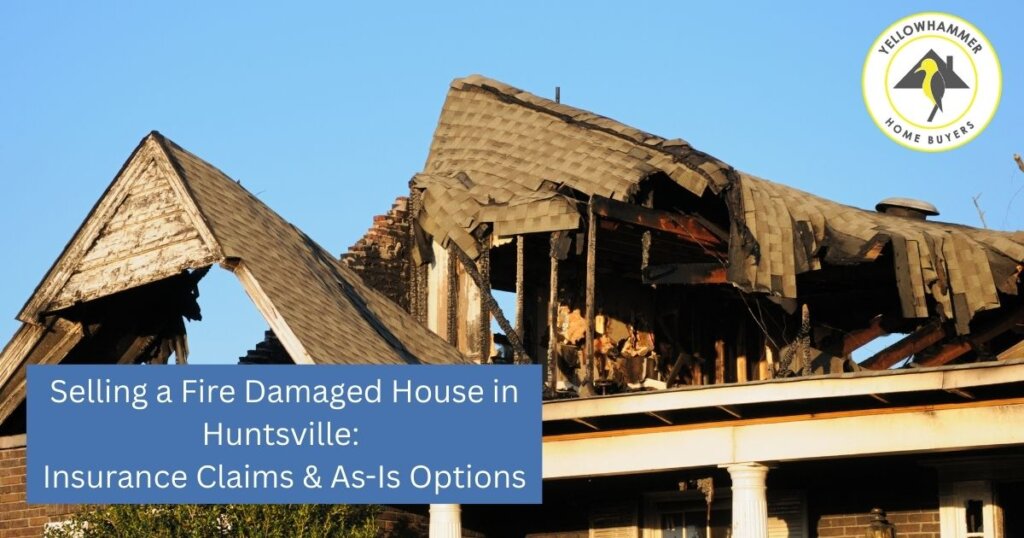
The fire trucks are gone. The smoke has cleared. Your Huntsville house is still standing, but it’s damaged – maybe a little, maybe a lot. And now you’re trying to figure out what comes next.
Do you rebuild? Do you sell? What does insurance actually cover? Can you even sell a house with fire damage? How long does all this take?
I’m Brandon, and my partner David and I run Yellowhammer Home Buyers. We’ve purchased several fire-damaged properties in Huntsville and throughout North Alabama. I’m going to walk you through your real options, what insurance actually covers, and when selling as-is makes more sense than rebuilding.
What Fire Actually Damages (Beyond What You Can See)
Most people think fire damage is just the burned areas. It’s way worse than that.
Direct Fire Damage
This is the obvious stuff:
- Burned walls, floors, ceilings
- Destroyed rooms or sections
- Structural damage to framing, roof, foundation
- Complete loss of areas where fire burned hottest
Smoke Damage Throughout the House
Smoke travels everywhere, even to rooms untouched by flames:
- Soot coating on walls, ceilings, furniture
- Smoke smell soaked into everything
- HVAC system contaminated with smoke
- Ductwork needs professional cleaning or replacement
- Insulation absorbed smoke and needs replacement
That smoke smell doesn’t just air out. It’s in the drywall, in the insulation, in the studs. You can’t paint over it or spray air freshener and fix it.
Water Damage from Firefighting
Firefighters dumped hundreds or thousands of gallons of water inside your house. That causes:
- Water damage to floors, walls, ceilings
- Mold growth starting within 24-48 hours
- Electrical systems compromised by water
- Foundation water intrusion
- Damaged belongings from water, not fire
The Hidden Damage
- Electrical wiring might be compromised even in areas that look fine
- Plumbing might have burst from heat
- HVAC system is usually toast
- Windows might be cracked from heat
- The house might not be structurally sound
A fire inspector has to clear the structure before anyone can even safely enter to assess damage.
What Insurance Actually Covers
Let’s talk about what your homeowner’s insurance policy really does and doesn’t cover.
Standard Homeowner’s Policy Coverage
Dwelling coverage: Pays to repair or rebuild the structure
Personal property coverage: Pays for damaged belongings
Additional living expenses: Pays for hotel or rental while house is uninhabitable
Debris removal: Pays for cleanup of fire debris
Sounds comprehensive, right? Here’s where it gets complicated.
The Actual Cash Value vs. Replacement Cost Problem
Replacement Cost Coverage: Pays to rebuild with today’s materials and prices
Actual Cash Value: Pays replacement cost minus depreciation
If you have Actual Cash Value coverage (cheaper premiums), your payout might not cover full repairs. A 15-year-old roof doesn’t get replaced with a new roof under ACV – you get the depreciated value.
What Insurance Doesn’t Cover
Code upgrades: If your house was built in 1975, it doesn’t meet 2026 building codes. Rebuilding means upgrading electrical, plumbing, insulation, everything to current code. Basic policies don’t cover this extra cost.
Landscaping: Dead trees, damaged lawn, destroyed bushes – usually limited coverage or none
Detached structures: Garage, shed, fence – separate coverage limits apply
Your deductible: You pay $1,000-$5,000 out of pocket before insurance pays anything
According to the National Fire Protection Association, the average home fire causes $50,000 to $75,000 in damage, but insurance claim disputes are common when restoration costs exceed initial estimates.
The Claims Process Reality
Week 1-2: File claim, adjuster visits, initial damage assessment
Week 2-4: Adjuster provides initial payout estimate
Week 4-8: You get restoration quotes that are higher than adjuster’s estimate
Week 8-16: Negotiating with insurance about actual costs
Month 4-8: Finally agreeing on payout amount
Month 8-12+: Actually completing repairs
This process often takes 6-12 months and is incredibly stressful. You’re fighting with your insurance company while displaced from your home.
The Real Cost of Fire Restoration
Let’s talk about what it actually costs to restore a fire-damaged Huntsville house.
Minor Fire (Kitchen Fire, Limited to One Room)
Damage: One room burned, smoke throughout house
Restoration costs:
- Fire damage repair in affected room: $15,000-$25,000
- Smoke remediation throughout house: $10,000-$15,000
- HVAC cleaning or replacement: $3,000-$12,000
- Repainting entire interior: $5,000-$8,000
- Replace flooring: $5,000-$10,000
Total: $38,000-$70,000
Timeline: 3-6 months
Moderate Fire (Multiple Rooms, Significant Smoke)
Damage: Several rooms burned, major smoke damage, some structural issues
Restoration costs:
- Fire damage repair: $40,000-$80,000
- Smoke remediation: $15,000-$25,000
- Structural repairs: $10,000-$30,000
- New roof (if damaged): $10,000-$15,000
- HVAC replacement: $8,000-$12,000
- Complete interior rebuild: $30,000-$50,000
Total: $113,000-$212,000
Timeline: 6-12 months
Major Fire (Most of House Damaged)
Damage: Extensive fire throughout, major structural damage, possible total loss
Options:
- Full restoration: $150,000-$300,000+
- Tear down and rebuild: $200,000-$350,000+
Timeline: 12-18+ months
At this level of damage, many homeowners realize rebuilding costs more than the house is worth.
Your Options After Fire Damage
Let’s talk about what you can actually do with a fire-damaged house in Huntsville.
Option 1: File Insurance Claim and Rebuild
Best for: People with good insurance coverage, who want to stay in the house, and have time to deal with the process
Timeline: 6-18 months typically
Process:
- File claim immediately
- Document everything with photos/video
- Get multiple restoration quotes
- Fight with insurance adjuster about coverage
- Hire restoration contractor
- Live elsewhere during repairs (insurance covers this)
- Move back when complete
Problems:
- Takes 6-18 months
- Constant stress dealing with insurance and contractors
- Final payout often less than actual costs
- You might have to cover shortfalls out of pocket
- Living in temporary housing for months
Option 2: Take Insurance Money and Sell As-Is
How it works:
- File insurance claim
- Get your payout (minus deductible)
- Use that money however you want
- Sell the damaged house as-is
Why this works:
- Insurance pays you for the damage
- You sell the damaged house and keep insurance money
- No months of dealing with contractors
- Move on with your life immediately
The catch:
- Your insurance payout might not fully cover market value loss
- Selling fire-damaged house means lower price
- But you avoid the stress and time of restoration
Option 3: Sell As-Is Without Repairs
Best for: Most people who don’t want to deal with months of restoration
Timeline: 2-3 weeks to sell to cash buyer
How it works:
- File insurance claim (you’re required to)
- Get whatever insurance pays you
- Sell house as-is to investor like us
- We factor in all fire damage into our offer
- Close fast and move on
Why this often makes the most sense:
Let’s say your Huntsville house was worth $200,000 before the fire. Fire caused $75,000 in damage.
If you restore it:
- Insurance pays: $70,000 (after fighting for every dollar)
- You pay deductible: -$2,500
- You cover shortfall: -$7,500
- 8 months of stress dealing with contractors
- House back to $200,000 value
- Still have to sell it traditionally (3-4 months)
- Pay 6% commission when selling: -$12,000
- Net after 1+ year: ~$177,500
If you sell as-is to us:
- Insurance pays: $70,000
- We buy damaged house: $135,000 (factoring in all damage)
- Total you get: $205,000
- Close in 2-3 weeks
- Zero stress, zero contractors, zero waiting
- Net immediately: $205,000
You actually net MORE by selling as-is than rebuilding and selling later.
Can You Actually Sell a Fire-Damaged House?
To traditional buyers with financing: Almost never. Their lender won’t approve a loan on a fire-damaged property. It’s considered uninhabitable until restored.
To cash buyers like us: Absolutely yes. We buy fire-damaged houses all the time. We factor the restoration costs into our offer and handle everything after we own it.
What We Do With Fire-Damaged Houses
People always ask: “What do you actually do with a burned house?”
Our Process
Step 1: Complete professional assessment of all damage (fire, smoke, water, structural)
Step 2: Get permits from City of Huntsville for restoration work
Step 3: Hire professional fire restoration contractors
Step 4: Complete all repairs to code (this is what we do – we’re investors who fix houses)
Step 5: Either resell after restoration or rent it out
This is our business. We know fire restoration contractors, we understand the costs, we have the capital and expertise to handle it. You don’t have to become an expert in fire restoration on top of everything else you’re dealing with.
How We Buy Fire-Damaged Huntsville Houses
Here’s our actual process:
Step 1: You Contact Us About the Fire
Call (256) 795-3014 or contact us online. Tell us:
- When the fire happened
- What areas were damaged
- Whether you’ve filed insurance claim
- Current condition of the house
Step 2: We Assess the Damage
We visit the property (once fire marshal clears it as safe). We bring contractors who specialize in fire restoration to assess true costs.
Step 3: Written Cash Offer
We provide a detailed offer:
Pre-fire market value: $200,000
minus Fire restoration costs: $75,000
minus Our holding costs and selling costs: $30,000
minus Our profit margin: $25,000
equals Your offer: $70,000
Plus whatever your insurance pays you. So if insurance pays $70,000, you’re getting $140,000 total.
Step 4: Close When You’re Ready
Once insurance claim is processed (or even before if you need to), we close. Usually 2-3 weeks from accepted offer.
Working With Your Insurance Company
Even if you sell to us, you still need to file an insurance claim. Here’s why:
You’re contractually required: Your policy requires you to report claims
You get paid: Insurance still pays you even if you sell the house
You don’t commit fraud: Failing to report a claim is insurance fraud
The payout is yours: You can use insurance money however you want
We can work with you while insurance processes your claim. Some homeowners close before insurance pays, some wait for insurance payout first. Either way works.
FAQ: Selling Fire Damaged House
Q: Can I sell before insurance claim is processed?
A: Yes. We can make you an offer and close regardless of insurance claim status.
Q: Do I have to restore the house first?
A: Not if you sell to us. We buy it as-is with all fire damage.
Q: What if insurance claim is denied?
A: We still buy the house based on current condition and market value.
Q: Can you close fast?
A: Yes. Often 2-3 weeks, though some people prefer to wait for insurance payout first.
Q: What if the house is a total loss?
A: We might still buy the land or the structure depending on the situation.
Q: Will you buy if there’s still fire debris inside?
A: Yes. We handle all cleanup and debris removal after closing.
The Bottom Line
After a house fire in Huntsville, you don’t have to spend 6-18 months fighting with insurance companies and managing contractors just to get your house back to where you can sell it.
You can sell it as-is, keep your insurance payout, close in weeks, and move forward with your life.
Had a house fire in Huntsville? Contact us or call (256) 795-3014 to discuss your options.